Pokemon TCG Rarity Guide 2026: Every Symbol Explained, How to Spot an SIR, and What Makes a Card Valuable
Pokemon TCG Rarity Guide 2026: Every Symbol Explained, How to Spot an SIR, and What Makes a Card Valuable
You have just opened a pack of Pokemon TCG cards and something looks different. One card is shining in a way the others are not. Another has a symbol in the corner you have not seen before. And somewhere at the back of the pack there is something with elaborate artwork that covers the entire card face. Is any of it worth keeping? Is it worth protecting? Is any of it valuable?
These are questions that come up constantly, whether you are brand new to the hobby or returning after years away. The rarity system in the Pokemon TCG has changed dramatically since the days of the original Base Set, and the modern version is considerably more layered than the simple circle, diamond, star structure that most people grew up with. This guide explains everything: every rarity symbol in the current system, how to find and read them, the critical difference between a black star and a gold star, how to spot a Special Illustration Rare, what secret rares are and how to identify them, and what actually determines a card's value beyond its rarity alone.
Where to Find the Rarity Symbol on a Pokemon Card
Every Pokemon TCG card printed in English since 1999 carries a rarity symbol. On modern cards from the Scarlet and Violet era onwards, the rarity symbol sits at the bottom left corner of the card, next to the card number. On older cards the position varied slightly, sometimes appearing in the bottom right, but on any card released in the current era you will always find it bottom left.
The rarity symbol is a small icon. On lower rarity cards it will be a simple geometric shape. On higher rarity cards it will be one or more stars, and crucially, the colour of those stars matters enormously. Getting into the habit of checking the bottom left corner immediately when you pull a card from a pack is one of the most useful instincts you can develop as a collector.
The Basic Symbols: Common, Uncommon, and Rare
These three form the foundation of the rarity system and have existed since the game launched in 1996.
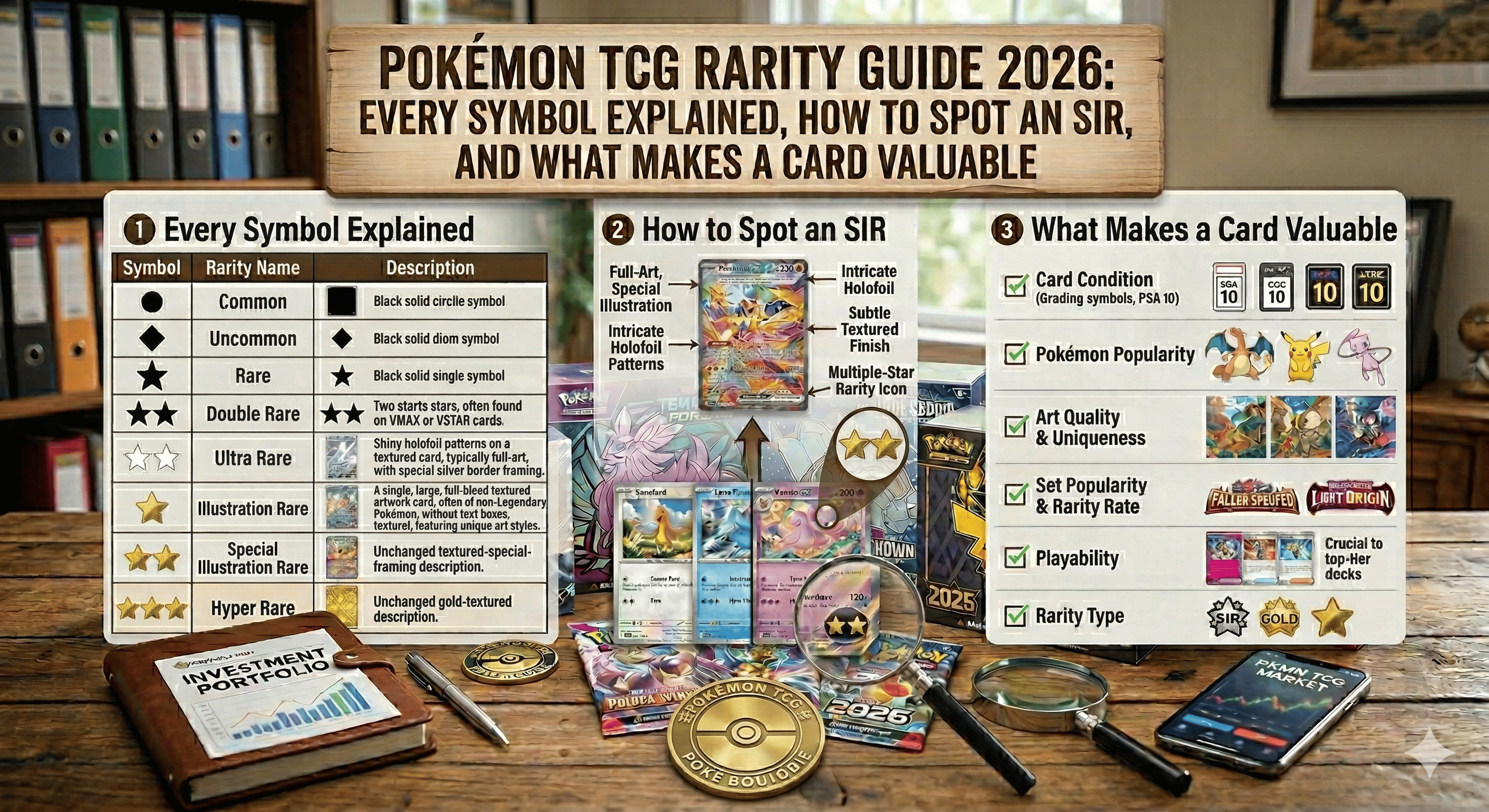
A filled black circle means the card is Common. Commons make up the majority of any booster pack and appear several times per pack. They have very limited monetary value in the modern era but are essential for gameplay. Most of the basic Pokemon and standard Item cards you need to build a functional deck are Commons.
A filled black diamond means the card is Uncommon. Uncommons appear roughly three to four times per pack and are slightly harder to find than Commons. Like Commons they have limited collector value but are important gameplay pieces, particularly Stage 1 Pokemon and specialist Trainer cards.
A filled black star means the card is Rare. Standard Rares appear roughly once per pack and from the Scarlet and Violet series onwards all Rares have a holographic foil finish on the artwork area. A single black star tells you the card is a Rare but does not tell you how rare. From here the system branches into multiple tiers and the colour and number of stars becomes critical.
The Modern Rarity Tiers: Where Things Get More Complex
From the Scarlet and Violet series onwards, The Pokemon Company expanded the rarity system significantly to reflect the increased variety of card types and finishes. Understanding this expanded system is what separates collectors who know what they are holding from those who do not.
Double Rare
Two black stars mean the card is a Double Rare. In the current era, Double Rares are Pokemon ex cards. They pull at roughly one per five packs and are the first tier where you can expect modest but real secondary market value, typically ranging from a few pounds to around twenty pounds depending on the Pokemon and the set. The black colour of the two stars is the key identifier: two black stars mean Double Rare, which is meaningfully different from two gold stars.
Ultra Rare
Two silver stars mean the card is an Ultra Rare. Ultra Rares are full art ex cards with borderless artwork that extends across the entire card face and a textured foil finish. They pull at roughly one per 20 packs and sit in the mid tier of collector value. If you pull a card with two silver stars and beautiful borderless artwork, you have something genuinely worth protecting with a top loader.
Illustration Rare
One gold star means the card is an Illustration Rare. This is where the modern Pokemon TCG starts to look significantly different from older sets. Illustration Rares feature full scene painted artwork where the illustration extends across the entire card including the borders, creating compositions that feel more like fine art prints than traditional trading card illustrations. They pull at roughly one per nine packs in recent sets and range from a few pounds to forty or fifty pounds depending on the subject matter. If you pull a card with one gold star and artwork that fills the entire card in a detailed painted scene, that is an Illustration Rare.
Special Illustration Rare (SIR)
Two gold stars mean the card is a Special Illustration Rare. This is the category that generates the most excitement, commands the highest values below the very top of the rarity ladder, and causes the most confusion among collectors who are not yet familiar with the current system.
The critical distinction is this: two black stars mean Double Rare (worth a few pounds). Two gold stars mean Special Illustration Rare (potentially worth hundreds of pounds). The number of stars is the same. The colour is entirely different. Always look at the colour of the stars, not just how many there are.
Special Illustration Rares feature full scene painted artwork featuring Pokemon ex and Trainer characters in artistic compositions. The artwork is elaborate, often featuring environmental detail, character interaction, and a cinematic quality that stands entirely apart from standard card illustration. SIRs also carry a textured foil finish that you can feel with your fingertip, giving the card a tactile quality that standard cards do not have. Cards like Mega Gengar ex SIR from Ascended Heroes and Umbreon ex SIR from Prismatic Evolutions are SIRs that have sold for hundreds of pounds. They pull at roughly one per 70 to 100 packs depending on the set.
When you pull a card with two gold stars, elaborate full scene artwork, and a textured finish you can feel, you have an SIR. Sleeve it immediately.
Hyper Rare
Three gold stars mean the card is a Hyper Rare. Hyper Rares are the rarest cards found in standard booster packs and feature a complete gold foil treatment across the entire card. In the Mega Evolution era, the Mega Hyper Rares for cards like Mega Charizard Y ex and Mega Dragonite ex from Ascended Heroes fall into this category and pull at approximately one per 540 packs. The all gold treatment with fine linework is distinctive and unmistakable.
Mega Attack Rare
Two stars, one pink and one green, identify a Mega Attack Rare. This is a brand new rarity introduced in Ascended Heroes in 2026 and exclusive to Mega Evolution Pokemon ex in the current era. Mega Attack Rares feature full art illustrations with the Pokemon's signature attack name rendered in stylised Japanese katakana overlaid directly onto the card art, giving them a comic book panel aesthetic unlike any other card type in the modern TCG. The distinctive pink and green star combination makes them immediately identifiable once you know what to look for.
How to Identify a Secret Rare Using the Card Number
Secret Rares are a category that catches a lot of collectors out because they do not have a single consistent rarity symbol. Instead, you identify them through the card number printed at the bottom left alongside the rarity symbol.
Every Pokemon TCG set has an official card count. A standard numbered card from a set of 295 cards will show a number like 047/295, meaning it is card 47 of 295. A Secret Rare has a card number that exceeds the official set total. If a set has 217 cards in the main set but you are holding a card numbered 240/295, that card falls in the secret rare range above the main numbered set. This is how you spot a Secret Rare regardless of what rarity symbol it carries.
In the Ascended Heroes set, the SIRs, MARs, and Mega Hyper Rares are all numbered above 217, the main set total. Cards numbered 218 through 295 are the secret rare section. Any card with a number higher than the base set count deserves a close look.
The Star Colour Summary You Need to Memorise
This is the single most useful piece of knowledge for quickly assessing a card's rarity tier.
One black star is a standard Rare. Two black stars is a Double Rare, meaning a Pokemon ex card of standard value. Two silver stars is an Ultra Rare, a full art ex with meaningful collector value. One gold star is an Illustration Rare with a full painted scene and genuine collector appeal. Two gold stars is a Special Illustration Rare, one of the most valuable cards in any modern set. Three gold stars is a Hyper Rare, the rarest standard pull in the set. Two stars in pink and green is a Mega Attack Rare, a new rarity from the current Mega Evolution era.
If you remember nothing else from this guide, remember: black stars and gold stars look similar at first glance but represent completely different value tiers. A Double Rare Pokemon ex might be worth two pounds. An SIR of the same Pokemon could be worth two hundred. Always check the colour.
Reverse Holos: What They Are and Why They Are Not Usually Valuable
Almost every card in a Pokemon TCG set has a reverse holo variant. This is a version of the card where the holographic foil treatment appears across the entire card background rather than just in the artwork window. Reverse holos look sparkly and impressive but they are not rare in any meaningful sense. Most sets produce a reverse holo version of nearly every non ex card in the set and they pull frequently in standard packs.
The exception in the current era is Ascended Heroes, which introduced a more complex reverse holo system featuring multiple distinct patterns. In Ascended Heroes, non ex Pokemon cards have two reverse holo variants: an Energy pattern reverse holo and a Poke Ball pattern reverse holo specific to each Pokemon. These are more interesting from a collecting perspective but still not high value individually. Master set collectors need all three versions of each non ex Pokemon card, which is part of why the Ascended Heroes master set is such a significant undertaking.
Promo Cards: The Exception to Every Rule
Promo cards sit outside the standard rarity system entirely. They are marked with a black star containing the word PROMO and are never found in standard booster packs. Instead they come bundled with retail products, handed out at events and tournaments, or included as exclusive extras in special collections.
The value of a promo card is determined entirely by its availability and demand rather than by a rarity symbol. Some promos handed out at events in limited quantities have become extraordinarily valuable. Others that came with widely available products are worth very little. The Tyrunt foil promo from the Perfect Order Elite Trainer Box and the N's Zekrom promo from the Ascended Heroes ETB are current examples of promo cards with meaningful collector value due to their exclusive distribution.
Rarity Symbol vs Actual Value: The Important Distinction
One of the most common misconceptions among new collectors is that a card's rarity symbol directly determines its value. Rarity symbols indicate how frequently a card appears in packs relative to other cards in the same set. They do not directly determine real world demand or price.
Several factors combine to determine what a card is actually worth. The rarity tier sets the baseline scarcity. The Pokemon featured determines collector demand because some Pokemon have enormous fanbases and some do not. The artwork quality matters because collectors in the modern TCG respond strongly to distinctive or emotionally resonant illustrations. The condition of the card affects value significantly, with near mint copies commanding premiums over played or damaged cards. And the overall size and reception of the set affects how much product has been opened, which influences how many copies of any given card are in circulation.
An SIR featuring a popular Pokemon with outstanding artwork in excellent condition is worth far more than a technically rarer Hyper Rare featuring a less popular Pokemon. A Double Rare of a Pokemon with no competitive or collector following may be worth almost nothing despite technically being rarer than a Common. Rarity is a starting point for assessing value, not a conclusion.
What to Do When You Pull Something That Looks Valuable
The practical advice for when you pull a card with silver or gold stars, a card numbered above the main set total, or a card with a full painted scene artwork is straightforward. Sleeve it immediately with a penny sleeve before handling it further. Do not put it loose in a pile of other cards, face down on a surface, or in your pocket. Surface scratches on foil and textured cards are often invisible in normal light but show up clearly under bright light or grading scrutiny and reduce value significantly.
Once sleeved, check the card number against the set total to confirm whether it is a secret rare. Then look up the specific card on a secondary market platform to get a sense of its current value before deciding whether to keep it in a standard binder sleeve or upgrade it to a rigid top loader or hard case.
For cards that appear to be high value SIRs or Hyper Rares, consider whether grading through PSA or CGC is worth the cost. Grading authenticates the card and assigns a condition grade. A PSA 10 grade commands a significant premium over the raw card price for popular cards, but grading has submission costs and wait times that need to factor into your decision.
Where to Find the Cards Worth Pulling in 2026
The current Mega Evolution series is producing some of the most visually distinctive and collectible Special Illustration Rares the Pokemon TCG has seen in years. Ascended Heroes features 22 SIRs including Mega Gengar ex and Mega Dragonite ex at the top of the value ladder. Perfect Order and Chaos Rising, arriving May 2026, continue the series with new Mega Evolution debuts and their own SIR lineups.
All current Mega Evolution era sealed product is available at CardDeckr, including single booster packs, Elite Trainer Boxes, tins, blister packs, and more. Every pack you open is another chance to pull the cards described in this guide. Visit carddeckr.com to browse current stock, check availability, and sign up for a free account to get 5% off your order.
Pokémon and all related names are trademarks of Nintendo, Creatures Inc., GAME FREAK inc., and The Pokémon Company. CardDeckr is not affiliated with The Pokémon Company International.