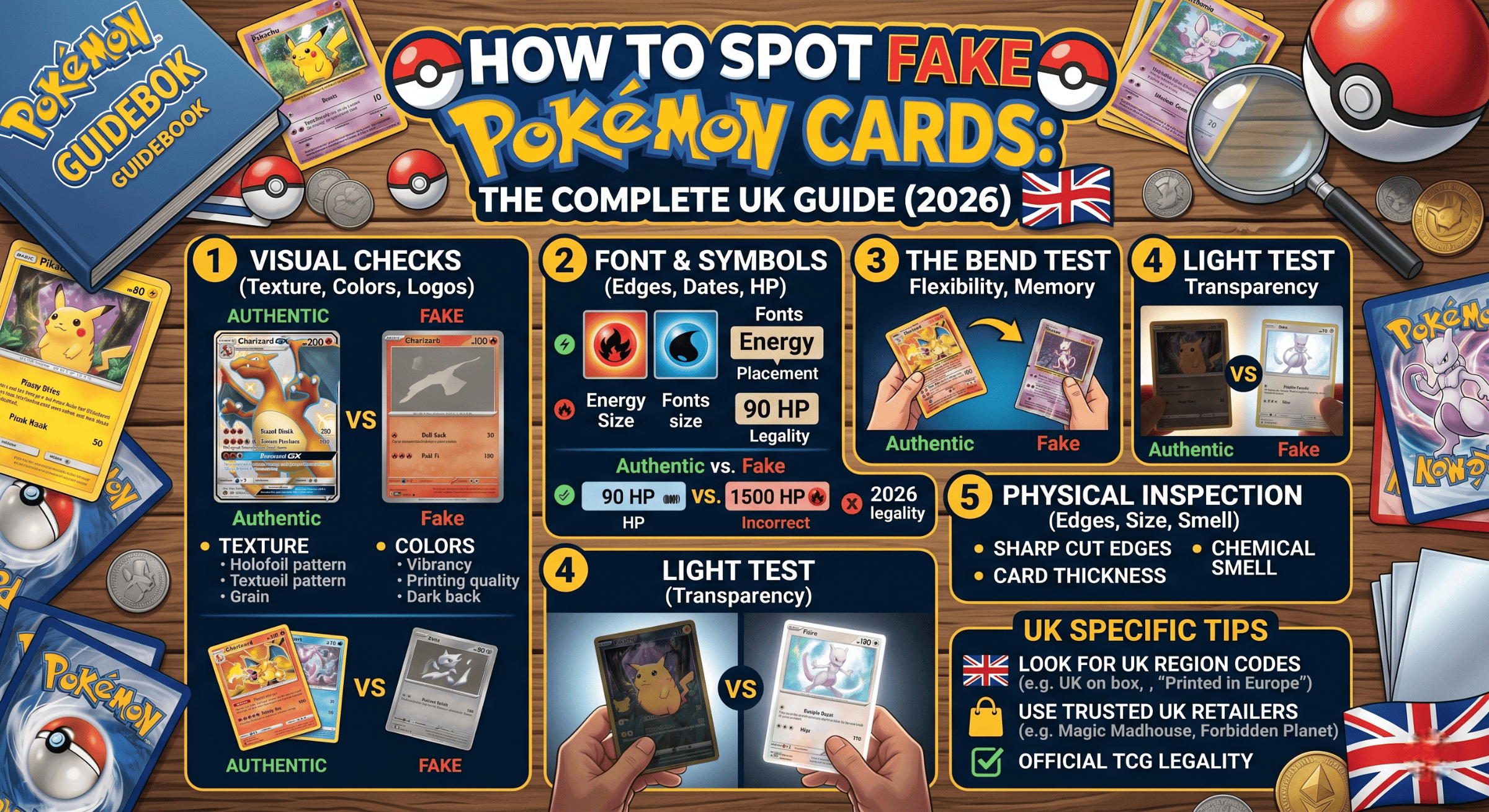
How to Spot Fake Pokemon Cards: The Complete UK Guide (2026)
How to Spot Fake Pokemon Cards: The Complete UK Guide (2026)
Counterfeit Pokemon TCG cards and resealed products are a bigger problem in the UK market in 2026 than at any previous point in the hobby's history. The growth of the hobby has made it a lucrative target for counterfeiters, and the sophistication of modern fakes has improved significantly from the obviously wrong colours and blurry text of early reproductions. Some fakes circulating today are convincing enough to fool newer collectors on first inspection, and estimates suggest tens of millions of pounds worth of counterfeit Pokemon product moved through online marketplaces in 2025 alone.
This guide gives you every tool you need to protect yourself. How to test individual cards, how to identify fake sealed product, where counterfeits are most commonly found, what the specific tells are for modern sophisticated fakes, and how buying from a verified UK retailer like CardDeckr removes the risk entirely. Whether you are spending a few pounds on a pack or several hundred on a single card, knowing how to authenticate what you are buying is not optional in 2026.
The Light Test: Your First Line of Defence
The fastest and most reliable initial test for a single card requires nothing more than a phone torch. Hold the card up to the light beam with the front of the card facing you. A genuine Pokemon TCG card is constructed from three distinct layers: two printed outer layers with an opaque black or dark grey core layer sandwiched between them. When held to a bright light, an authentic card will show a faint, even, slightly warm glow but you will not be able to read the text on the back or see the reverse image through the card. It will appear as an opaque sheet with a mild translucency.
A fake card typically fails this test in one of two ways. Either it is too transparent, meaning light passes through it too easily and you can see the back clearly through the front, or it has no visible layered structure at all. The opaque core layer is the single hardest manufacturing detail for counterfeiters to replicate accurately and its absence or incorrectness is the most reliable indicator of a fake card. Run this test on every high value card you are considering buying as a single.
The Card Back Test: The Most Underrated Check
The back of a genuine Pokemon TCG card has a very specific colour profile. The blue used in the swirling Pokeball design is a particular shade that counterfeiters consistently struggle to match. Around 80 percent of counterfeit cards can be identified through the back design alone, specifically by looking at the area just above and to the right of the central Pokeball. On genuine cards this section shows a subtle gradient between lighter and darker blue tones that gives the background visual depth. Fake cards frequently render this as a flat, uniform blue with no gradient depth.
The Pokeball itself is another useful check point. On genuine cards the design is crisp and the proportions are precise. On fakes the Pokeball is often slightly off in scale, position, or colour balance. Familiarise yourself with what a genuine Pokemon card back looks like by looking at authenticated cards on the official Pokemon database or from your own verified collection, and use that as your reference point.
Text Quality and Typography
Genuine Pokemon TCG cards are printed using proprietary typefaces that are not publicly available. Counterfeiters have to approximate these fonts by eye, and the results are never perfect. Look closely at the text on any card you are authenticating and check for the following signs of a fake.
The accent on the e in Pokemon is one of the most commonly missed details on counterfeit cards. Every instance of the word Pokemon on a genuine English card carries the acute accent over the e. A missing accent anywhere on the card is an immediate red flag. Check the evolution text, the card description, the attack text, and the copyright line at the bottom.
Letter spacing is another reliable tell. Genuine cards have carefully controlled tracking and kerning, meaning the spacing between letters is consistent and balanced throughout. Fake cards frequently have spacing that is too wide or too cramped in places, with inconsistency across different sections of the same card. Look at a paragraph of attack text and check whether the letter spacing looks natural and consistent.
Print sharpness matters most in the small text. The copyright line and set information at the very bottom of the card are printed in tiny type. On a genuine card this text is crisp and fully legible under a magnifying glass. On a fake it is often blurry or has bleeding edges where the ink has not resolved cleanly. Blurry small text is one of the most reliable and consistent indicators of a counterfeit card.
Card Feel and Texture
Authentic Pokemon TCG cards have a specific feel that experienced collectors recognise immediately. The weight is consistent at approximately 1.7 to 1.8 grams and the thickness is around 0.31 to 0.32 millimetres. Significant deviation from these figures suggests a counterfeit. If you have access to a precision digital scale, weighing a suspect card against a confirmed authentic card of the same era is a highly reliable test.
The flexibility of the card matters too. A genuine card bends slightly under gentle pressure and springs back cleanly to flat. Cards that feel too stiff, too flimsy, or do not return to flat after bending are worth examining more carefully. This test requires some experience with genuine cards to calibrate your expectations, as the feel varies somewhat across different eras of printing.
For modern rare cards with textured foil finishes, the texture itself is a powerful authentication tool. Special Illustration Rares, Hyper Rares, and Mega Attack Rares from the current Mega Evolution era carry specific textured finishes that are extremely difficult and expensive to replicate. If a card that should have textured foil feels smooth, or has a texture that does not feel consistent with genuine cards from the same set, treat it with suspicion. Counterfeiters are increasingly adding fake texture effects but the patterns are rarely accurate when compared to genuine cards under close inspection.
Card Dimensions and Corners
Every official English Pokemon TCG card is 63 millimetres wide and 88 millimetres tall. The corner radius on genuine cards is approximately 3 millimetres, giving a specific and consistent rounded corner shape. Counterfeit cards often fail on dimensions, cutting slightly short or slightly large in ways that are visible when placed against a genuine card. Corners on fakes are frequently slightly too sharp, slightly too rounded, or have an uneven radius that feels rough to the touch.
Edges are another check point. Genuine cards have smooth, cleanly cut edges that feel consistent all the way around. Rough edges, visible cardboard fibres on the edge, or uneven cutting are all indicators of a lower quality manufacturing process than The Pokemon Company uses.
Holographic Patterns
The holographic foil used on genuine Pokemon TCG cards produces a specific rosette pattern when examined under a 10x magnifying loupe or jeweller's loupe. Under magnification, genuine cards show a clean, consistent pattern of overlapping dots that create the illusion of solid colours when viewed at normal distance. Counterfeit foil typically shows a different, often cruder pattern under magnification, or uses a continuous sheet of metallic foil rather than the printed dot rosette structure of genuine cards.
Without a loupe, the way the holographic effect catches and reflects light at different angles is another guide. Genuine holo cards have a consistent, deep shimmer that shifts smoothly as you tilt the card. Fake holo effects often look flat, produce a blotchy pattern, or shift in ways that do not match the behaviour of genuine cards from the same era.
How to Spot Fake Sealed Product
Counterfeit and resealed sealed product is in many ways more dangerous than individual fake cards because the financial stakes are higher and the signs are harder to spot without knowing what to look for.
Resealed packs are individual booster packs that have been carefully opened, the valuable cards removed, and the pack resealed with new low value cards inside. The most reliable tell for a resealed individual pack is the wrapper seal itself. Genuine factory sealed packs have clean, consistent heat seal lines along the top and bottom edges with a very specific width and texture. Any waviness, inconsistency in seal width, adhesive residue near the seal, or unusual crinkle in the wrapper material around the seal area is a significant red flag.
Resealed boxes and Elite Trainer Boxes have their own tells. The shrink wrap on a genuine sealed box is applied with precision and sits tightly against the box surface. Resealed boxes often have shrink wrap that is looser than expected, has visible heat gun marks from being reapplied, or has seam lines that do not match the factory shrink wrap pattern. The flap of the box itself is another check: genuine factory sealed product has undisturbed glue or tape on the box flap that shows no signs of previous opening.
Full counterfeit sealed products, where the entire product is manufactured to imitate genuine product, typically give themselves away through incorrect branding, wrong card counts, or product configurations that do not match official releases. If a product claims to contain far more valuable cards than a genuine product would, or references sets or card types that do not exist in that product, it is a fake. No genuine booster pack is going to guarantee ex cards or SIRs in every pack. If the packaging promises this, walk away.
Where Fake Pokemon Products Are Most Commonly Found
Understanding where counterfeits circulate most frequently is the simplest form of protection. The highest risk sources for counterfeit Pokemon TCG product in the UK are unverified third party sellers on Amazon and eBay, private sales on Facebook Marketplace and Vinted, market stalls and car boot sales, and any online listing where the price is significantly below what established retailers are charging. If a product is priced at 40 or 50 percent less than the market rate, there is almost always a reason for that. Genuine Pokemon TCG product does not sell dramatically below retail from trustworthy sources.
Amazon in particular is a source of significant confusion for buyers. Amazon's fulfilled by Amazon product listings are generally reliable, but third party seller listings vary enormously in reliability and the marketplace has historically been used to distribute counterfeit Pokemon product. Always check the seller name, feedback history, and whether the product is fulfilled by Amazon directly or by a third party when buying from Amazon.
The Pokemon Company themselves have stated that flea markets and market stalls represent some of the highest instances of counterfeit sales they encounter. Buying in person from an unverified source at what appears to be a good price is one of the highest risk purchasing decisions in the hobby.
Fake Graded Cards: An Additional Layer of Risk
Counterfeiters have extended their operations to graded cards in recent years. The specific risks are fake slabs containing real cards, fake slabs containing fake cards, and genuine slabs with altered or replaced certification labels. When buying a graded card, always verify the certification number printed on the slab label directly on the PSA, CGC, or BGS verification portal before completing a purchase. These verification portals are free to use and a genuine graded card from any of these companies will return a confirmed result matching the card details exactly. A certification number that returns no result or returns a different card is a clear indication of fraud.
Why Buying from CardDeckr Protects You Completely
Every product sold through CardDeckr is factory sealed and sourced exclusively through verified UK distribution channels. CardDeckr is a registered UK company, company number 17076419, operating from 124-128 City Road, London. We are a legitimate, accountable business operating within UK consumer protection law.
When you buy sealed product from CardDeckr you are buying factory sealed product that comes through verified UK distribution channels. Nothing is opened, resealed, or tampered with. The product you receive is exactly as it left the factory. Every product is authentic, guaranteed.
This matters because the counterfeit problem in the UK market is real and growing. The peace of mind that comes from buying sealed Pokemon TCG product from a verified UK retailer with a registered company number and a physical address is not a small thing. It is the difference between knowing you have the genuine product and hoping you do.
All products at CardDeckr accept major credit and debit cards, Apple Pay, Google Pay, and Klarna through secure Stripe checkout. Your payment information is protected and your order is fully traceable.
Quick Reference: The Authenticity Checklist
Before buying any single card of significant value, work through this checklist. Hold the card to a bright light and look for the opaque layered structure. Check the card back for the correct shade of blue and gradient depth near the Pokeball. Examine the text for the accented e in Pokemon and consistent letter spacing throughout. Check the small copyright text at the bottom for crispness and legibility. Feel the card for appropriate weight, flexibility, and finish. For foil cards, check that any texture matches genuine examples from the same set. Compare dimensions against a verified authentic card if possible.
For sealed product: inspect the wrapper seals for consistency and factory precision. Check the shrink wrap on boxed products for correct tightness and seam position. Research the official product configuration and verify that what is claimed on the packaging matches what genuine versions contain. And above all, consider the source. If you are buying from a source you cannot verify and the price seems too good to be true, it almost certainly is.
The Easiest Way to Avoid Fake Pokemon Cards
The single most effective protection against counterfeit Pokemon TCG product is buying from a verified UK retailer whose authenticity you can confirm. CardDeckr exists precisely to give UK collectors a trustworthy, transparent source for genuine factory sealed product. Browse the current range at carddeckr.com, sign up for a free account to get 5% off every order, and shop with the confidence that every pack you open is the real thing.
Pokémon and all related names are trademarks of Nintendo, Creatures Inc., GAME FREAK inc., and The Pokémon Company. CardDeckr is not affiliated with The Pokémon Company International. CardDeckr Ltd is registered in England and Wales, company number 17076419.