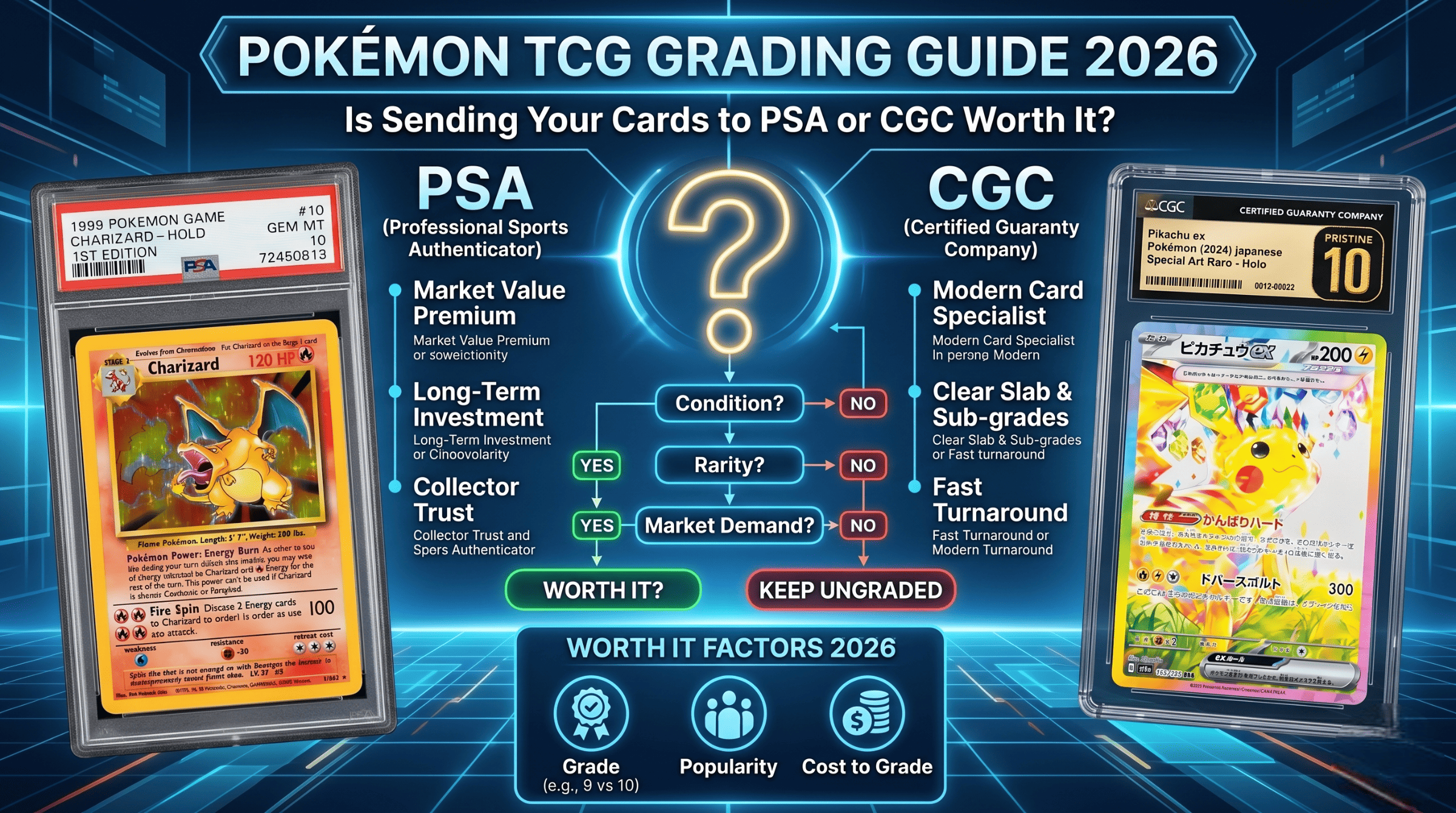
Pokemon TCG Grading Guide 2026: Is Sending Your Cards to PSA or CGC Worth It?
Pokemon TCG Grading Guide 2026: Is Sending Your Cards to PSA or CGC Worth It?
You have pulled something significant. An SIR from Ascended Heroes, a Mega Hyper Rare, or a high value Illustration Rare that you believe is in excellent condition. The question that naturally follows is whether you should get it graded. A PSA 10 on a popular card can be worth multiples of its raw equivalent. The grading cost and wait time are real. And the risk of receiving a lower grade than expected is something every collector who has submitted cards has experienced at least once.
This guide gives you an honest and complete answer. What grading actually is, what the three major services offer and how they compare, which cards are actually worth the cost and hassle of submitting, what you should realistically expect to pay from the UK, how turnaround times look in 2026, and how to prepare and send cards properly so they arrive in the best possible condition.
What Is Pokemon Card Grading?
Professional grading is the process of having an independent authentication company evaluate a card's condition, assign it a numeric grade on a one to ten scale, and seal it permanently inside a tamper proof plastic holder called a slab. The label on the slab confirms the card's identity, the grade it received, and a certification number that can be verified on the grading company's website.
The grade reflects the physical condition of the card at the time of submission, assessed across four main criteria: centering (how well aligned the printed image is within the card borders), corners (the condition of all four corners, which are the most vulnerable to wear), edges (the smoothness and integrity of all four card edges), and surface (the condition of both the front and back face, including any scratches, print lines, or foil damage).
A PSA 10 or CGC Gem Mint 10 indicates a card in essentially perfect condition across all four criteria. These are rare. Most cards submitted for grading, even cards that look perfect to the naked eye, receive grades in the eight to nine range due to issues that only become visible under the close inspection and specialist lighting conditions used by professional graders. Going into grading with realistic expectations about grade distribution is essential.
Why Grade at All?
The financial case for grading the right cards is compelling. A PSA 10 on a high value Pokemon card can sell for significantly more than the same card in raw condition, with premiums ranging from modest on mid tier cards to extraordinary on popular chase cards and vintage rarities. PSA 10 copies of top Ascended Heroes SIRs have been selling for multiples of the equivalent raw card price. Grading also authenticates the card permanently, which matters for high value purchases and long term collection security.
The non financial case is simpler: a graded card is protected forever. Inside a sealed slab, a card cannot be scratched, bent, or damaged by handling. For cards you intend to keep permanently and display, grading is the ultimate preservation method.
The case against grading is also worth being honest about. The costs are real. The wait times are long. The risk of receiving a lower grade than expected can turn a sensible financial decision into a loss. And for cards that are not worth a meaningful amount in raw condition, the grading fee will never be recovered regardless of the grade received. Grading is not the right decision for every card and a clear framework for which cards to submit is the most important part of any grading strategy.
PSA, CGC, and BGS: The Three Services Compared
Three companies dominate the Pokemon card grading market in 2026. Each has different strengths, weaknesses, turnaround times, and market positioning.
PSA: Professional Sports Authenticator
PSA is the oldest and most established grading company, founded in 1991, and holds approximately 70 percent of the graded Pokemon card market. The PSA 10 Gem Mint grade is the most recognised in the hobby and commands the highest resale premiums across the secondary market. PSA uses a straightforward one to ten scale with no subgrades, meaning you receive a single definitive number that the entire market understands.
The PSA premium for Pokemon cards is real but narrowing. Two years ago PSA 10 copies of popular modern cards sold for 20 to 25 percent more than equivalent CGC grades. In 2026 that gap has compressed to roughly 5 to 10 percent for modern cards, though the premium remains larger for vintage cards where PSA's dominance is more entrenched. For UK collectors, PSA currently operates submission drop off points through authorised middlemen including Subcentre, which routes cards via their Canadian facilities. PSA has also announced a Frankfurt grading centre expected to open in summer 2026, which will give EU and UK collectors a more accessible submission route once operational.
CGC: Certified Guaranty Company
CGC has grown rapidly in the Pokemon card market, capturing approximately 25 percent market share in 2025 and continuing to grow into 2026. Critically for UK collectors, CGC operates a dedicated UK office at cgccards.uk, meaning cards can be submitted directly without the customs complications or international shipping costs associated with sending to North America. Multiple authorised UK dealers also accept cards for CGC submission and hand deliver to CGC's London office.
CGC uses a one to ten scale and additionally offers a Pristine 10 grade above standard Gem Mint 10 for cards in exceptional condition, which has developed genuine scarcity premium in the market for certain popular cards. Turnaround times are generally faster than PSA at equivalent price points, and base submission costs are somewhat lower. CGC 10 grades typically sell for approximately 72 to 85 percent of equivalent PSA 10 prices for modern Pokemon cards, making CGC the more cost efficient option for cards where maximum resale value is not the primary goal.
BGS: Beckett Grading Services
BGS is the third major option and is best known for its subgrade system, which scores centering, corners, edges, and surface individually in addition to the overall grade. The coveted BGS Black Label 10 requires all four subgrades to be perfect 10s and is extraordinarily rare, commanding significant premiums when it appears on popular cards. BGS is generally the preferred choice for collectors who want maximum transparency about a card's specific condition profile rather than a single overall grade. However, BGS Pokemon cards typically sell for less than equivalent PSA grades on the open market, and the service has been losing market share. UK submission is available through authorised middlemen.
Which Cards Are Actually Worth Grading?
This is where most grading guides fail to give a useful answer and where the most money is wasted by collectors who submit cards that the maths does not support. The principle is straightforward: a card is worth grading when the expected value of the graded card, accounting for realistic grade distribution, exceeds the cost of grading plus the time value of your money over the wait period.
A practical starting threshold used widely across the collector community is that a card should be worth a meaningful amount in raw condition before grading is worth considering. Cards worth only a few pounds in raw condition will almost never justify grading costs regardless of the grade received. Cards worth significantly more in raw condition have a genuine case for grading if they are in strong condition and the PSA 10 or CGC 10 premium on that specific card is substantial.
For 2026, the cards most worth considering for grading from a financial perspective are Special Illustration Rares and Mega Hyper Rares from Ascended Heroes and Perfect Order where the PSA 10 population is still low, popular Illustration Rares that have established collector demand beyond just gameplay, and vintage cards where condition rarity and PSA's brand dominance creates the largest premiums.
Cards that are rarely worth grading include Double Rares and standard ex cards where the raw value is modest, Illustration Rares of less popular Pokemon where collector demand is limited, and any card where the PSA 10 population is already high enough to compress the premium significantly.
Condition Assessment: Doing This Before You Submit
The most expensive mistake in grading is submitting cards without accurately assessing their condition first. Grading fees are charged regardless of the grade received. A card you expected to grade PSA 10 that comes back PSA 8 is both a financial loss on the grading cost and a potential loss on the card value itself, since a low grade can make a card harder to sell than the same card ungraded.
Assess your cards under bright, angled light before submitting. Angled light is the critical tool for spotting surface scratches, print lines, and foil damage that are invisible under direct overhead lighting. Tilt the card slowly while holding it under a bright LED lamp and look for any reflective imperfections. Check corners under a magnifying loupe if you have one. Look at both edges and all four corners for any wear, whitening, or chipping. Evaluate centering by looking at the border widths on all four sides: severe miscentering is an automatic barrier to top grades regardless of how perfect the rest of the card is.
Being honest with yourself at this stage saves significant money. If a card has visible surface issues under angled light, it will not receive a top grade. Submit cards you genuinely believe are in strong condition and accept that the grade you receive is the professional assessment of its actual condition, not a reflection of how much you paid for it or how much you want it to be a ten.
How to Submit Cards for Grading from the UK
The submission process differs between services but the core steps are consistent.
For PSA from the UK, the most practical route currently is through an authorised UK middleman such as Subcentre, which handles the logistics of batching submissions to PSA's facilities and returning graded cards to UK addresses. This avoids international shipping complications and the associated customs costs. Always verify current turnaround estimates and costs directly with the middleman before submitting as these change frequently.
For CGC from the UK, direct submission to CGC's UK office is available through cgccards.uk. Authorised UK dealers who hand deliver to CGC's London office are also an option for collectors who prefer a local intermediary. The direct UK submission route is one of CGC's most significant practical advantages for UK collectors in 2026.
Regardless of which service you use, follow these packaging steps precisely to ensure cards arrive in the best possible condition. Place each card into a standard penny sleeve first, inserting it top first with no friction. Slide the penny sleeved card into a Card Saver 1 semi rigid holder. PSA specifically prefers Card Savers over rigid top loaders. Do not use tape, sticky notes, or any adhesive anywhere near the card or the holder. Place your card stack in the exact order listed on your submission form. Sandwich the stack between two pieces of sturdy cardboard secured with rubber bands that are snug but not tight enough to apply pressure to the cards. Insure the package for the full value of the cards inside. Underinsuring to save on costs provides inadequate protection if the package is lost or damaged in transit.
Turnaround Times in 2026
Turnaround times vary significantly by service tier and submission volume. Always verify current estimates directly with the grading company or middleman before submitting as these figures change frequently, particularly around major set releases and holiday periods when submission volumes spike.
As a general picture for 2026, PSA standard submissions have improved significantly from the 2021 to 2022 backlog period and UK submissions through authorised middlemen have been returning in the 45 to 60 business day range. Faster tiers are available at higher cost. CGC from the UK is generally returning standard submissions in the 42 to 44 week window at the time of writing, with an express service available at higher cost. BGS turnaround through UK middlemen sits broadly in the 25 to 35 pound per card range with similar timeline expectations to PSA.
Factor the wait time honestly into your decision. Money tied up in cards awaiting grading is money that cannot be used elsewhere for three to six months or more. For cards you intend to keep permanently, this is less of a concern. For cards you want to sell in the near term, a several month wait before the card reaches market may not align with your goals.
PSA vs CGC: Which Should You Choose for Modern Pokemon Cards?
For most UK collectors submitting modern Pokemon TCG cards in 2026, the decision comes down to two questions: is maximum resale value the priority, and how long are you willing to wait?
If maximum resale value is the priority and you are submitting high value cards where the 5 to 10 percent PSA premium matters meaningfully, PSA is the correct choice. The brand recognition, market dominance, and collector preference for PSA in the Pokemon community is real and translates to genuine premium on the secondary market, particularly for vintage cards and the highest value modern chase cards.
If you are submitting modern cards primarily for your own collection, or if faster turnaround and lower cost are priorities, CGC's direct UK submission route makes it an increasingly compelling option. The CGC 10 premium gap has narrowed significantly over the last two years and CGC is building genuine trust in the Pokemon collector community at a pace that suggests the premium gap will continue to shrink.
Many experienced collectors use both services depending on the specific card: PSA for their highest value vintage and modern chase submissions where premium maximisation matters, CGC for their collection piece submissions where speed, cost, and the convenience of direct UK submission are the primary considerations.
Condition Starts When You Open the Pack
The most important practical point about grading is one that is easy to overlook. A card's condition is determined the moment it leaves the pack. Every subsequent handling, every time it sits unsleeveed, every time it is placed face down on a surface, adds potential for damage that cannot be undone. A PSA 10 is only achievable on a card that has been treated perfectly from the moment it was pulled.
This means that the single best thing you can do to maximise your grading outcomes is to open packs properly. Have penny sleeves ready before you start. Pull each card carefully and sleeve it immediately without bending, touching the surface unnecessarily, or placing it down on any surface unprotected. Top load anything that looks valuable straight away. The difference between a PSA 9 and a PSA 10 is frequently a single surface scratch that happened during pack opening or the first few minutes of handling.
Buying factory sealed product from a verified UK retailer like CardDeckr means every pack you open has been handled correctly from the factory. Nothing has been searched, resealed, or tampered with. The cards inside are in the best possible starting condition. That foundation matters for grading outcomes more than most collectors realise.
Check current stock at carddeckr.com, sign up for a free account to get 5% off your order, and open your packs knowing that what you pull from verified sealed product is starting from the best possible place.
Nothing in this guide constitutes financial or investment advice. Grading costs, turnaround times, and resale premiums change frequently. Always verify current information directly with grading companies before submitting. Pokémon and all related names are trademarks of Nintendo, Creatures Inc., GAME FREAK inc., and The Pokémon Company. CardDeckr is not affiliated with The Pokémon Company International.